True Automation Explained: What Real Revenue Cycle Automation Should Deliver
Many systems promise automation, but only a few actually remove the manual work behind the scenes. RMS’s True Automation changes that by reducing the tasks that slow down your teams, improving accuracy across remits and correspondence, and strengthening the financial performance of your organization.
Here is what True Automation really means, and why it matters for healthcare finance.
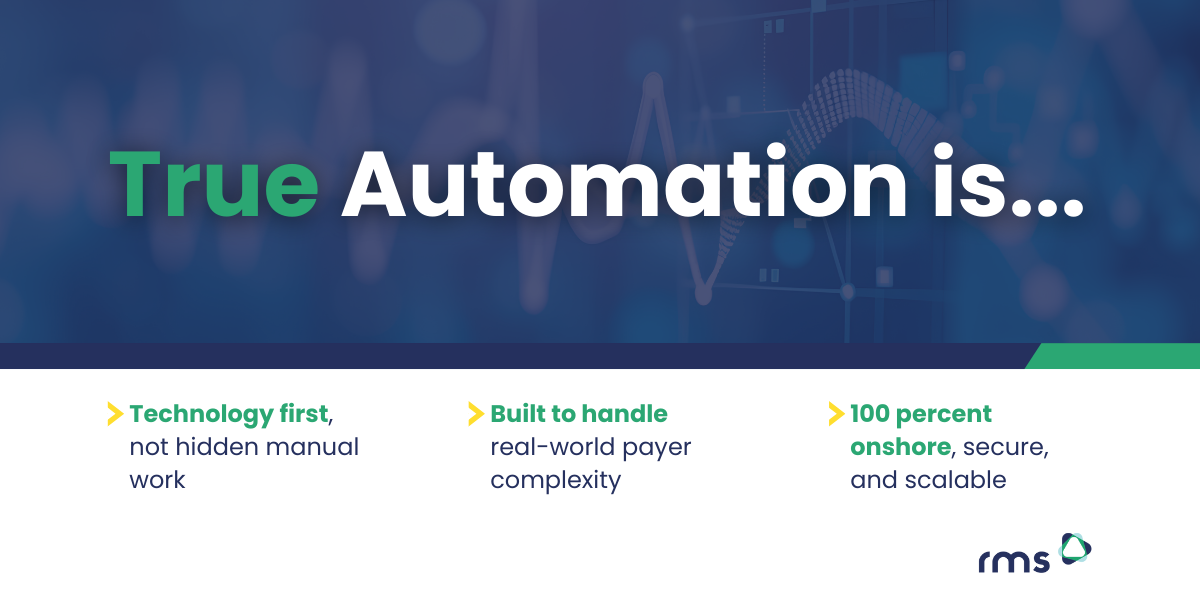
True Automation is… technology first
A lot of “automation” in the industry still depends on offshore teams manually keying data behind the scenes. It may look automated on the surface, but the hardest work is still done by people, not technology.
True Automation uses advanced AI models to extract, validate, and reconcile payment information. It reduces dependency on human intervention and eliminates delays, forced-balance exceptions, and the security concerns that come with manual work.
The benefit: cleaner files, faster turnaround, and fewer downstream corrections.
True Automation is… built to handle the real-world complexity of healthcare payments.
Healthcare remittances are rarely straightforward, and automation only works when it can interpret the variability that payers introduce. RMS is designed to support the complexities that typically create bottlenecks.
Examples include:
- PLB adjustments: RMS interprets and applies PLBs accurately so financials stay clean and reconciled.
- Transaction cuts: RMS separates and processes lockbox deposits at the transaction level to maintain accuracy across bank feeds.
- Document splitting: RMS separates multi-document PDFs or bundled remits so each item is processed correctly.
- Custom payer settings: RMS tailors conversions based on provider and payer needs so outputs match your internal workflows instead of a generic template.
The benefit: customized workflows that avoid duplicate work created by one-size-fits-all automation.
True Automation is… 100 percent onshore for speed, security, and stability.
All processing and exception handling occur in the United States. This provides stronger data protections, more consistent quality control, and faster communication when something needs attention.
During industry disruptions, U.S. based operations also provide stability and predictable turnaround times, which helps prevent delays in posting and reconciliation.
The benefit: secure, consistent processing with complete peace of mind about where your data goes.
True Automation is… intelligent correspondence management that reduces daily workload.
Correspondence is one of the most overlooked sources of operational drag in the revenue cycle. That is why RMS recently enhanced our Correspondence AI to support:
- Intelligent routing into a broader range of document queues
- More than 98 percent payer name matching
- Continuous learning that adapts as payer formatting changes
- Enterprise-level scalability, compliance, and reliability
This reduces the time staff spend searching, sorting, or manually indexing information, and helps business office teams act quickly on denials, audit letters, attachments, and other critical items.
The benefit: more efficient workflows and greater visibility across the documents that support your remittance and posting activities.
True Automation is… an investment in ROI that strengthens financial performance.
At its core, True Automation uses AI to reduce manual work, improve accuracy, and accelerate cash movement. This helps organizations protect their margins and maximize the impact of the technology they invest in.
Healthcare leaders need solutions that:
- Reduce cost to collect
- Shorten posting cycles
- Decrease rework
- Improve financial accuracy
- Protect staff time
- Create visibility across payments and adjustments
The benefit: a stronger financial foundation supported by consistent workflows and a revenue cycle team that runs on accuracy and efficiency.
The result is…
A revenue cycle that moves faster, works cleaner, and performs with greater accuracy. It is supported by technology that handles complexity rather than passing it back to your team. True Automation gives revenue cycle leaders the confidence and clarity they need to manage payments efficiently and strengthen financial results.
That is the foundation of True Automation, and why it is becoming a difference-maker for hospitals, health systems, and revenue cycle teams nationwide.
See How True Automation Can Transform Your Revenue Cycle
Ready to see the difference for yourself?
Explore how RMS delivers accuracy, transparency, and performance across the entire remittance lifecycle: https://rmsweb.com/contact