
October 5, 2026
·
3
min read

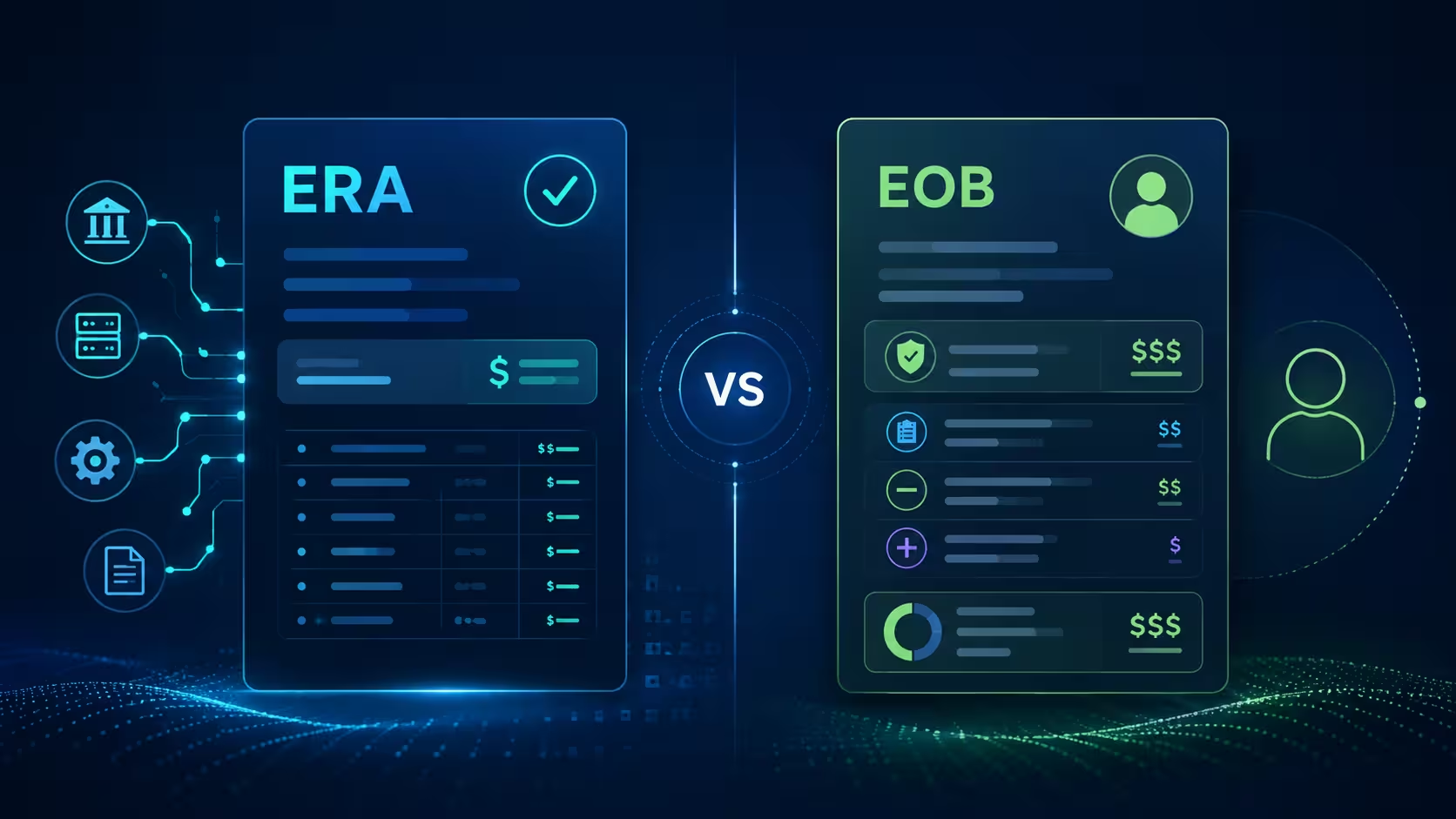
An EOB explains a claim to the patient; an ERA delivers the same adjudication to the provider as postable 835 data. Same payment event, two very different workflows.
An EOB (Explanation of Benefits) is a human-readable statement a health plan sends the patient to explain how a claim was adjudicated. An ERA (Electronic Remittance Advice) is the machine-readable version of the same adjudication, sent to the provider as a HIPAA-standard X12 835 file. Same payment event, two audiences: the EOB explains coverage to the member, while the ERA drives payment posting.
That answer covers most searches. For revenue cycle teams, though, the practical difference shows up in the payment posting queue, including the wrinkle most explainers skip: the paper “EOBs” providers still receive from payers that never send an 835. At Revenue Management Solutions (RMS), we post remittances in both formats for health systems every day, so this guide covers the textbook difference and the operational one.
An EOB is a plan-defined document that tells a patient what was billed, what the plan allowed, what it paid, and what the patient may owe. It is not a bill. Any balance due arrives later as a statement from the provider, which is why most EOBs carry the words “this is not a bill.”
The EOB is not a HIPAA standard transaction. No regulation dictates its layout, wording, or codes, so every payer formats it differently and describes adjustments in its own plain-language phrasing. It arrives on paper or as a portal PDF, addressed to the member; Medicare beneficiaries receive the equivalent Medicare Summary Notice (MSN) quarterly.
Because the EOB is written for a member rather than a system, it is not designed as postable remittance data. That distinction matters when a provider receives a paper or portal-based remit that contains useful adjudication information but cannot flow directly into an automated posting workflow.
An ERA is the electronic remittance advice a health plan sends the provider, formatted as the ASC X12N 835 version 5010 transaction — the format HIPAA mandates whenever remittance advice is sent electronically. In practice, “ERA” and “835” are used interchangeably: the ERA is the business document, and the 835 is the file it travels in.
The 835 carries claim- and line-level detail in standardized fields: billed, allowed, and paid amounts; patient responsibility; Claim Adjustment Group Codes (CO, PR, OA, PI); Claim Adjustment Reason Codes (CARCs); and Remittance Advice Remark Codes (RARCs). Those code sets are what make automated posting and denial analytics possible. One clarification for anyone new to X12 terminology: the claim goes out as an 837; the remittance comes back as an 835.
An ERA is not a payment — it explains one. The money moves separately as an EFT, typically via the NACHA CCD+ standard, while the 835 arrives on its own. The TRN reassociation trace number in the 835 links the bank deposit to its remittance detail so cash can be reconciled; RMS reconciliation teams lean on that TRN linkage daily, because the remit and the deposit rarely arrive on the same day. Under ACA Section 1104, the CAQH CORE EFT and ERA operating rules (adopted by HHS in 2012, effective January 1, 2014) require payers to support that reassociation, standardized ERA enrollment, and uniform CARC/RARC code combinations.
The difference between an EOB and an ERA comes down to audience and machine-readability: the EOB is a plain-language explanation for the patient, while the ERA is structured 835 data designed for the provider's downstream payment and reconciliation systems.
The patient-versus-provider framing is accurate but incomplete, because providers also receive paper remittances, and posting departments call them EOBs. Payers that don’t deliver 835s, such as smaller plans, workers’ compensation carriers, and certain government or specialty payers, send paper or portal-based remittance documents instead. They function as remittance advice, but they behave like patient EOBs: unstructured, payer-specific, and unpostable without human work.
That slice is smaller than it used to be, but it hasn’t disappeared. Medical-industry ERA adoption reached 89% fully electronic according to the 2024 CAQH Index, meaning roughly one in ten remittance transactions still arrives via portals, mail, fax, or phone. The same report puts the provider cost at $5.67 per manual remittance transaction versus $2.95 electronic. That $2.72 gap comes with an average of four minutes of staff time saved per transaction handled electronically. Industry-wide, CAQH estimates full ERA adoption represents a $695 million annual savings opportunity for medical alone.
At a health system posting millions of remittance transactions a year, 11% is not a rounding error. It is a standing team of people keying paper, and it is the volume RMS sees arrive in client mailrooms and lockboxes every week.
For payment posting, the distinction is simple: auto-posting only works from 835 data. Structured amounts and standardized adjustment codes post without interpretation; prose does not. Every remit that arrives outside the 835 lands in a manual queue, with three downstream effects.
First, cost and speed. The CAQH per-transaction figures above compound across every non-835 payer, and manual keying introduces the transposition and misapplication errors that clean 835 data avoids.
Second, duplicate-posting risk. When a payer offers both a portal remit and an ERA, the same payment can be worked twice. The 2024 CAQH Index notes that portal and ERA duplication “can lead to duplicate posting.”
Third, denial visibility. CARCs and RARCs feed denial dashboards, payer scorecards, and root-cause analytics. A stack of paper EOBs contains the same adjudication events, but the intelligence in them stays invisible to downstream systems until someone converts it into structured data.
We’ve seen this pattern across 20 years of remittance work at RMS: the electronic majority of a payer list posts cleanly, while a small paper minority consumes a disproportionate share of posting labor and reconciliation time.
Closing the EOB/ERA gap is a two-part effort: enroll where 835s exist, and convert where they don’t.
The first part is systematic ERA and EFT enrollment across the payer list. The CAQH CORE operating rules standardized how plans must support ERA enrollment, so a meaningful share of residual paper volume is recoverable simply by completing enrollments that were never done.
The second part is EOB-to-ERA conversion for payers that do not deliver an 835: paper and portal remits are captured, interpreted, standardized, and delivered as postable electronic output so the provider can maintain a more consistent downstream workflow. RMS uses an AI-first approach and proprietary, sophisticated AI to automate this work at scale, supported by payer-specific configuration and 100% U.S.-based operations. Since 2006, RMS has processed more than 1 billion healthcare transactions in the last five years alone. For the mechanics, see how EOB-to-ERA conversion works.
Yes, functionally. The ERA is the electronic remittance advice a health plan sends a provider, and the X12 835 is the HIPAA-mandated file format it travels in. Revenue cycle teams use the terms interchangeably: the 835 is the transaction standard, and the ERA is the document it delivers.
Yes. Payers that don’t deliver X12 835 files send providers paper or portal-based remittances, which posting teams commonly call provider EOBs. According to the 2024 CAQH Index, about 11% of medical remittance advice still arrives this way; that is the volume EOB-to-ERA conversion turns into postable 835 data.
No. The ERA explains a payment; the money moves separately, typically by EFT under the NACHA CCD+ standard. The two arrive independently, and the TRN reassociation trace number in the 835 links the bank deposit to its remittance detail so cash can be reconciled.
Because it is machine-readable. An 835 carries structured payment amounts and standardized CARC and RARC adjustment codes that posting systems apply automatically, while a paper EOB must be keyed or scanned. The 2024 CAQH Index puts the difference at $2.72 and about four minutes saved per transaction for providers.
Effectively, yes on request. HIPAA names the X12 835 as the standard for electronic remittance advice, and the CAQH CORE operating rules adopted by HHS in 2012 under ACA Section 1104, effective January 1, 2014, standardize how plans must support ERA enrollment, EFT reassociation, and uniform code combinations.
If part of your payer list still remits on paper or through portals, the opportunity is usually a mix of enrollment and conversion, evaluated payer by payer. Talk to RMS about doing a payer analysis to see where manual remittance work remains and where more of the workflow can be automated.
Sources cited: 2024 CAQH Index · HIPAA standard transactions (ACA Section 1104)· CAQH CORE EFT & ERA Operating Rules (77 FR 48008)
Explore the latest RMS news, insights, and resources in one place.
Automate · Optimize · Revolutionize
9020 North May Ave, Suite 100
Oklahoma City, OK 73120