October 26, 2026
·
7
min read


Remittance reconciliation is the process of matching each payer remittance, whether an X12 835 ERA or a paper EOB, against three things: the original claim, the actual bank deposit, and the posting in the patient accounting system. The math favors automation decisively. A manual remittance transaction costs the medical industry $6.24 versus $3.03 fully electronic, according to the 2024 CAQH Index — roughly double the cost per remit.
That per-transaction gap is only the visible part. Below, we walk through the cost, error, and speed math of manual reconciliation, including the outsourced manual-keying model, with numbers a CFO can rerun using their own volumes.
Remittance reconciliation is a three-way match: the payer’s remittance advice, the funds that actually moved, and the posting in the patient accounting system must all agree. The remittance side arrives either as an X12 835 electronic remittance advice, the HIPAA-mandated ERA transaction, or as a paper or portal EOB that has to be keyed or converted before it can post automatically.
Two technical details cause most of the pain. The first is reassociation. The EFT travels through banking rails while the 835 travels through EDI channels, so they arrive separately. Under the CAQH CORE 370 EFT & ERA Reassociation Rule, adopted federally under HIPAA, the health plan must carry a matching Reassociation Trace Number (TRN) in both the CCD+ EFT addenda and the corresponding 835, and must release the 835 within three business days of the EFT effective date, according to CMS guidance. Matching the two still falls on the provider.
The second is provider-level adjustments. Interest payments, recoupments, and withholds live in the 835’s PLB segment and do not tie to any single claim, while claim-level detail rides on CARC and RARC codes. These are precisely the items manual processes mishandle most often.
Health systems handle the manual vs automated remittance question through three operating models: in-house manual posting, outsourced manual keying, and AI-driven automation with human exception review.
In-house teams key paper EOBs, log into payer portals to download remits, and reconcile deposits against postings in spreadsheets. Outsourced manual keying, frequently offshore, ships EOB images to data-entry teams who re-key line items into 835 format at a low per-page rate. AI-driven automation converts paper and portal remittances into clean 835 data, reassociates payments to deposits automatically, and routes only true exceptions to trained staff.
Few organizations have finished the journey. Only 3.5% of healthcare organizations report completely automated payment reconciliation, while 72% are partially automated and more than 22% still run mostly manual workflows, according to a September 2025 HFMA survey of 241 hospital, health system, and medical group leaders. At Revenue Management Solutions, we see that middle group most often: for example, an EHR that auto-posts clean 835s while paper, portal, and correspondence volume quietly absorbs staff hours.
A manual remittance advice transaction costs the medical industry $6.24, versus $3.03 fully electronic, according to the 2024 CAQH Index — a $3.21 savings opportunity on every transaction. Provider labor accounts for most of it: $5.67 of the manual cost is staff time, versus $2.95 electronic.
Here is a worked example you can rerun with yourown team and salaries. Suppose three full-time employees handle EOB conversionand payer enrollments, and two more match ERAs to payments. If automation takesover 85% of the EOB and enrollment work, that is 3 x 8 hours x 0.85, or about20 staff hours per day. For ERA and payment matching, a conservative 50%automation rate frees 2 x 8 hours x 0.50, or 8 hours per day. Over a month of21 working days, that comes to roughly 600 staff hours, about three and a halffull-time employees. At the BLS median wage for medical records specialists of$50,250 per year, about $24 per hour before benefits, that is roughly $14,400 per month in base labor alone.
The hidden line item is portal volume. Per the 2024 CAQH Index, medical ERA adoption is 89% fully electronic, but 6% of remittances are still retrieved through payer portals and 5% arrive fully manually. Portal retrieval sounds electronic, yet it costs $5.31 in provider labor per transaction — nearly as much as fully manual. Roughly one remittance in ten still lives outside the 835 pipeline, which is why CAQH sizes full electronic adoption of remittance advice as a $695 million annual savings opportunity for the medical industry.
Every manually keyed remittance is a chance to introduce an error that automation would not make. Transposed payment amounts, a CARC mapped to the wrong adjustment category, a missed PLB interest payment or recoupment, a batch posted twice. Because PLB items do not tie to a single claim, keyers routinely drop or misapply them, and the deposit stops matching the postings.
The downstream costs are familiar to anyone who has watched payment posting go wrong: unapplied cash accumulating in suspense, misstated AR, month-end close delays, and secondary claims billed off incorrect balances. The HFMA reconciliation survey found that payment posting and reconciliation to the EHR is the single largest challenge, cited by 44.4% of respondents, followed by data inconsistencies across systems (over one-third) and staffing limitations (31.4%). Manual keying feeds all three.
Manual reconciliation is measured in days; automated reconciliation is measured in hours. Paper EOBs wait for mail, scanning, and batching. Portal remits wait for someone to log in. Outsourced keying adds shipment, batch turnaround, and time-zone lag before corrected files come back.
The CORE reassociation window compounds this. The 835 can legitimately arrive up to three business days after the EFT hits the bank account. If the matching work is also manual, you stack staff queue time on top of that regulatory window, and finance loses same-week visibility into which deposits are fully accounted for. Automated reassociation clears the TRN match the moment both sides arrive, so the exception queue holds only genuine mismatches.
Outsourced offshore keying wins on per-page price and loses on fully loaded cost. The model is labor arbitrage: images of EOBs and correspondence are shipped to offshore data-entry teams who re-key line items into 835 format. The rate card looks attractive. The economics erode in three places.
First, accuracy is bounded by keystrokes. Quality control is typically sampling-based, checking a percentage of batches, where machine validation can check 100% of fields against payer, claim, and deposit data. Errors that slip through come back as rework in your posting team’s queue, at your labor rate. Second, batch turnaround and time-zone lag add days to the cycle, which is precisely the metric reconciliation is supposed to shrink. Third, oversight burden: every offshore subcontractor in the chain is a HIPAA business associate your compliance team must diligence, contract, and monitor.
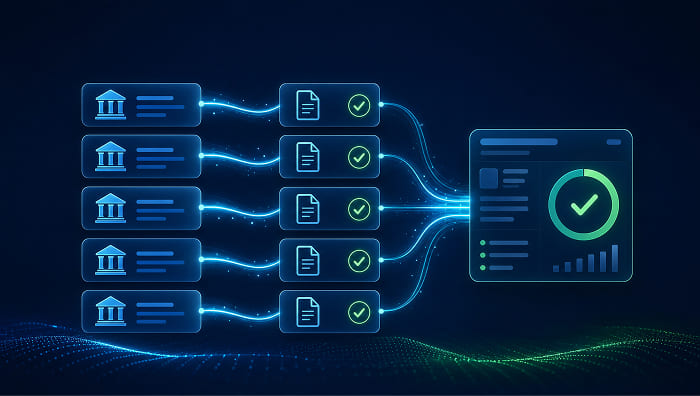
Automated remittance reconciliation converts every remit into clean 835 data, reassociates it to the deposit, and leaves humans only the exceptions. In practice that means EOB-to-ERA conversion for paper and portal remittances, automatic TRN-based reassociation, correct PLB handling, and an exception workqueue for the unmatched deposits and payer oddities that genuinely need judgment.
This is the model we built RMS around. Founded in 2006, we have spent 20 years doing remittance management. Our platform is AI-first with 100% US-based operations, and we have processed over 1 billion healthcare transactions in the last 5 years.
Five inputs are enough to price your own manual vs automated remittance gap. Pull them from a single recent month:
Multiply volume by touch time by labor rate for the direct cost, then layer rework and lag. If the result surprises you, you are in good company: most of that HFMA survey’s respondents are somewhere in the partially automated middle.
Remittance reconciliation is the process of matching each payer remittance (an X12 835 ERA or paper EOB) to three things: the original claim, the actual bank deposit, and the posting in the patient accounting system. It confirms the provider was paid what the payer said, and that the cash actually arrived.
About $6.24 per transaction for the medical industry, versus $3.03 fully electronic, according to the 2024 CAQH Index. Provider labor accounts for most of the gap: $5.67 manual versus $2.95 electronic, with roughly 4 minutes of staff time saved per transaction.
Because the EFT moves through banking rails while the 835 moves through EDI channels. CAQH CORE operating rules require health plans to carry a matching trace number (TRN) in both and to deliver the 835 within three business days of the EFT effective date, per CMS. Reconciling the two still falls on the provider.
It is usually cheaper per keystroke, not per remittance. Manual keying adds error-correction rework, batch turnaround delays, sampling-based QA instead of full validation, and the compliance overhead of offshore HIPAA business associate chains. Automation with US-based exception review typically wins on fully loaded cost, accuracy, and speed.
Almost entirely, but not 100%. Only 3.5% of healthcare organizations report complete automation, according to a 2025 HFMA survey. In practice, automation handles clean 835s, converted EOBs, and reassociation, while trained staff work a small exception queue of items like unmatched deposits and provider-level adjustments.
If you can pull last month’s manual and portal remit count, we can walk the rest of the numbers with you in one working session. Schedule a consultation with RMS.
Sources cited: 2024 CAQH Index Report · HFMA: Automated payment reconciliation emerges as critical gap in healthcare revenue cycle · CMS: EFT and ERA — Payment Remittance Reassociation Basics · CAQH CORE 370 EFT & ERA Reassociation (CCD+/835) Rule · U.S. Bureau of Labor Statistics, Occupational Outlook Handbook: Medical Records Specialists
Explore the latest RMS news, insights, and resources in one place.
Automate · Optimize · Revolutionize
9020 North May Ave, Suite 100
Oklahoma City, OK 73120