October 26, 2026
·
7
min read


Remittance management software converts payer payment explanations, both electronic 835 ERAs and paper EOBs, into posted, reconciled payments in a provider’s EHR or practice management system. This guide covers healthcare remittance software: six evaluation criteria, the questions worth asking in a demo, and the red flags that predict a painful rollout.
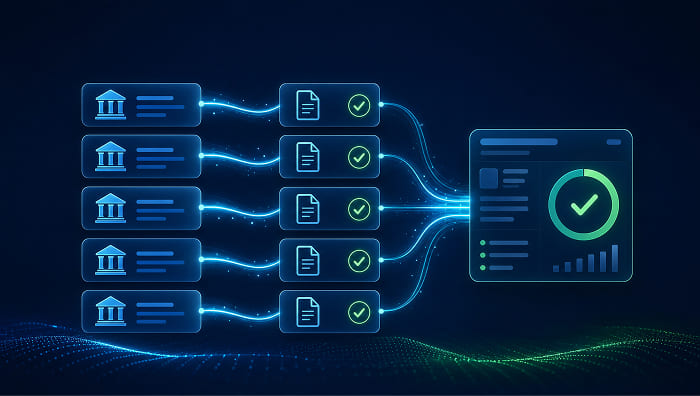
Remittance management software handles everything that happens after a payer pays: ingesting remittances, posting payments, reconciling payments against bank deposits, and routing the correspondence that arrives alongside them. It does not submit claims, code encounters, or work denials.
The category rests on five capabilities:
Remittance management software does not submit 837 claims, code encounters, or appeal denials. Those belong to clearinghouses and full RCM platforms such as Waystar, Optum, and Availity — adjacent to this category and, in practice, often integration partners rather than alternatives. A specialist remittance solution runs alongside your clearinghouse and EHR, not instead of them.
Most health systems in the $250 million to $5 billion net-patient-revenue range end up with a hybrid: software for the electronic majority of remits and a managed service for paper, correspondence, and exceptions. Vendors label the same offering remittance processing software, remittance automation, or lockbox services, so look underneath the branding at what you would actually operate.
The criteria below reflect what we at Revenue Management Solutions see decide these purchases, and what buyers wish they had asked before signing.
Every vendor claims high accuracy; the useful question is the denominator. Line-level accuracy (per service line posted) and batch-level accuracy (per file that loads) can differ enormously on the same operation. Get the accuracy definition in writing, the exception rate that accompanies it, and a contractual SLA.
The single most revealing metric is the percentage of remittances that post with zero human touch. “AI-powered” appears on nearly every vendor site, including some that are offshore manual keying operations with software in front. Ask how exceptions are queued and resolved, and whether the automation learns from them or the same errors recur every month.
HIPAA does not prohibit offshore processing, but it never relieves you of responsibility for it. OCR guidance holds the covered entity accountable for downstream safeguards, so an offshore vendor adds a diligence burden: subcontractor disclosure, BAA chains through every entity that touches PHI, and breach-notification logistics across jurisdictions. If a vendor is vague about where PHI is physically processed, treat the vagueness as your answer.
Integration claims need production proof, not roadmap promises. Verify the vendor delivers posting-ready 835 files or direct interfaces into your specific EHR; Epic compatibility on paper is not the same as a reference client live on your version. On the banking side, confirm the vendor handles lockbox intake and TRN-based reassociation of EFT deposits to 835s. Health plans have had to offer EFT and ERA on request since 2014, so the rails exist; the question is whether the vendor uses them cleanly.
Any remittance vendor touching PHI is a business associate and must sign a BAA; that is table stakes, not a differentiator. Beyond it, ask for a current SOC 2 Type II report, encryption in transit and at rest, workforce training attestations, and a complete subcontractor list. RMS covers the full checklist in our guide to HIPAA compliance for remittance automation.
Implementation timelines are driven less by the software than by payer EFT/ERA enrollments, bank lockbox setup, and EHR interface testing. Ask who owns the enrollment work, and how the vendor handles the 2024 CAQH CORE enrollment rule updates: fraud-detection measures, required EFT fee disclosure, and bulk-enrollment support. Our ACH/EFT and ERA enrollments guide explains why this workstream deserves its own project plan.
These ten questions map to the six criteria above.
A weak vendor fails quietly in the demo and loudly in month three. The patterns we see at RMS are consistent:
The economics of manual remittance work are documented. A manual remittance advice costs providers $5.67 per transaction versus $2.95 fully electronic, according to the 2024 CAQH Index; that $2.72 spread is the budget any software has to beat. The same report puts the time saved at about 4 minutes per transaction and sizes full ERA adoption as a $695 million annual savings opportunity for the medical industry. Every remit that needs a human touch costs roughly twice what it should. The wrong vendor locks that ratio in for a contract term.
Since 2006, Revenue Management Solutions has excelled at remittance management for healthcare providers. Twenty years of specialization is how we have processed over 1 billion healthcare transactions in the last 5 years, more than 200 million annually, with AI-first automation and 100% US-based operations.
Measured against the criteria above: our EOB-to-ERA conversion returns paper remits in the same 835 format your system already auto-posts. Our integrations are production-proven. Our operations never leave the United States, we are HIPAA-compliant, and headquartered in Oklahoma City.
Remittance management software converts payer payment explanations — electronic 835 ERAs and paper EOBs — into posted, reconciled payments in a provider’s EHR or practice management system. Core functions include ERA ingestion, EOB-to-ERA conversion, payment posting, payment-to-deposit reconciliation, and exception handling.
Remittance management software handles only what happens after the payer pays. Full RCM platforms also cover claims submission, coding, eligibility, and denial appeals. Many organizations run a specialist remittance solution alongside their clearinghouse and EHR rather than replacing either.
Typical implementations run from a few weeks to a several months, driven mostly by payer EFT/ERA enrollments, bank lockbox setup, and EHR interface testing rather than the software itself. Ask who owns payer enrollments before accepting any quoted timeline.
HIPAA does not prohibit offshore processing, but the covered entity remains responsible for downstream safeguards. Offshore operations add diligence burden: subcontractor disclosure, BAA chains, and breach-notification logistics. Ask where PHI is physically processed, and get the answer into the contract.
If you are building a shortlist, take the ten demo questions above into every conversation, including one with us. We will answer them honestly and even suggest doing a free payment cycle review to see where your revenue cycle operations have opportunities for efficiencies. Schedule a consultation with RMS.
Sources cited: 2024 CAQH Index · CMS.gov · CAQH CORE operating rules (ACA Section 1104) · HHS OCR guidance
Explore the latest RMS news, insights, and resources in one place.
Automate · Optimize · Revolutionize
9020 North May Ave, Suite 100
Oklahoma City, OK 73120